MX2 is the internal AI platform at Morgan & Morgan, the largest personal injury law firm in the US. I was lead designer for AI Chat & Doc Search, designing the intelligence layer from 0 to 1 so attorneys get instant, verifiable answers about any matter — powered by live Litify/Salesforce data.
TEAM
One of 3 designers building MX2, working with PM and engineering. Co-built the shared design system across AI Chat, the Word plugin, and Morgan Medical.
TIMELINE
2024 – Present · over a year, and still evolving.
SCOPE
Lead the end-to-end design of AI Chat & Doc Search; drive the Doc→Matter Chat product shift; co-own the design system.
2000+
weekly active legal professionals across attorneys, litigation & practice staff
1hr → min
medical-record review time, reported by the mass tort team
+17pp
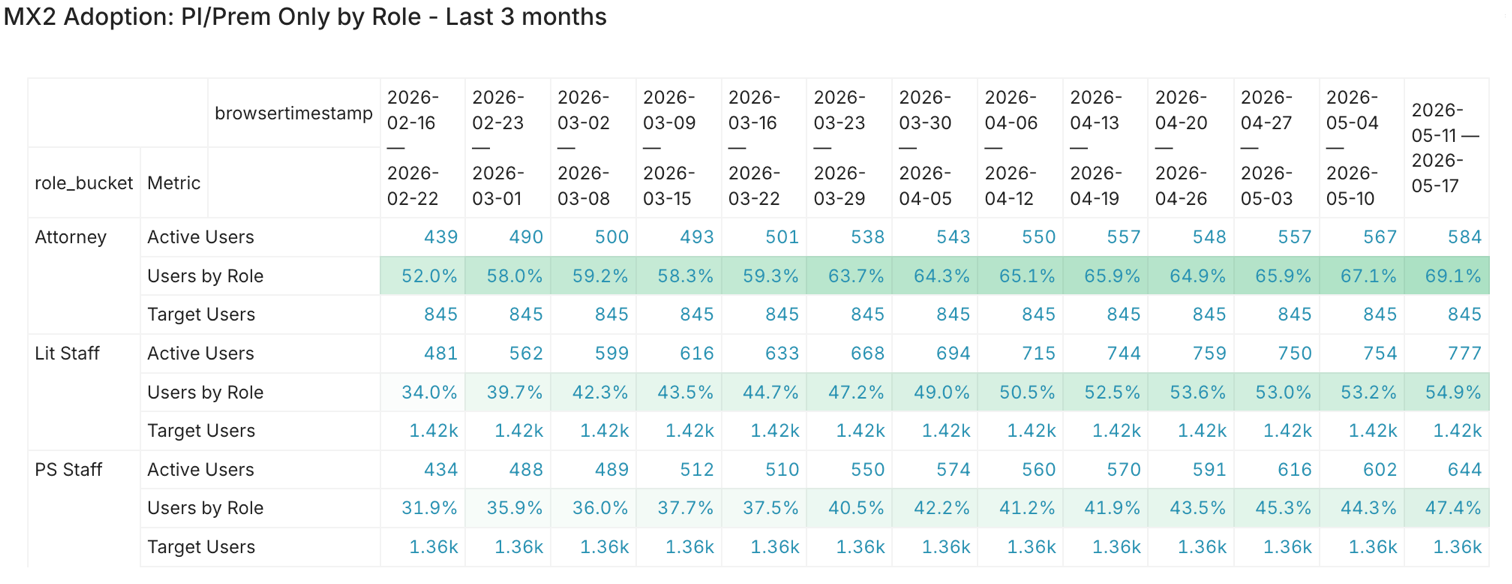
attorney adoption growth in 3 months (52% → 69%)
3
product surfaces unified by one shared design system
Attorneys couldn’t move at the speed their cases demanded
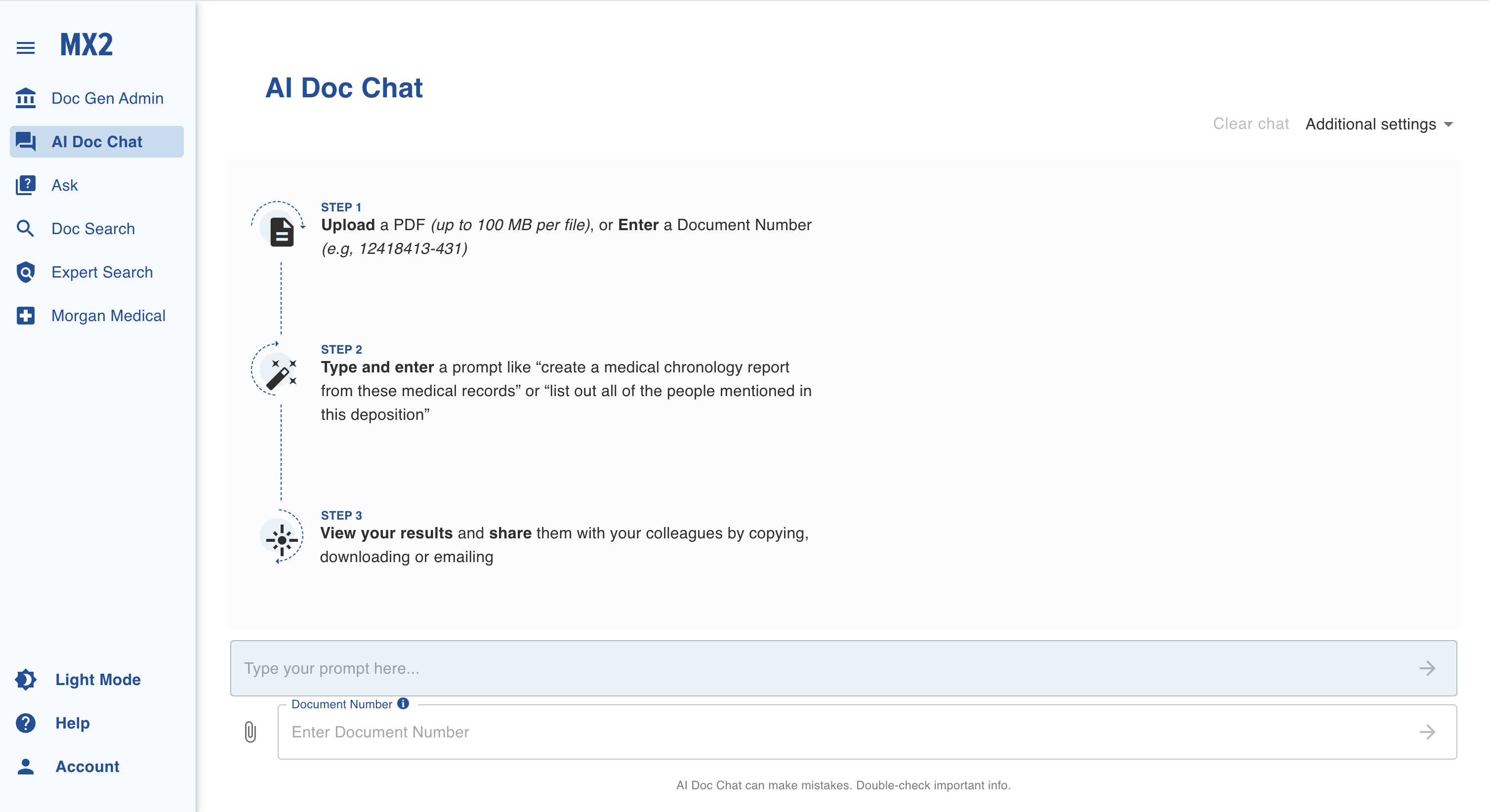
The first version — AI Doc Chat — made attorneys find and upload each PDF, or memorize a document number, just to ask a question about their own case. It was a document-first tool for people who think in cases.
01 • LACK OF CONTEXT
Manual document hunting. One file at a time. The AI never saw the whole matter, so every cross-document synthesis stayed manual.
02 • NO TRUST
Answers arrived with no citations. In court prep, an attorney can’t rely on what they can’t trace back to a source.
HMW give attorneys instant case intelligence without making them feed documents to the AI first?
I studied the legal-AI market
before placing our bets
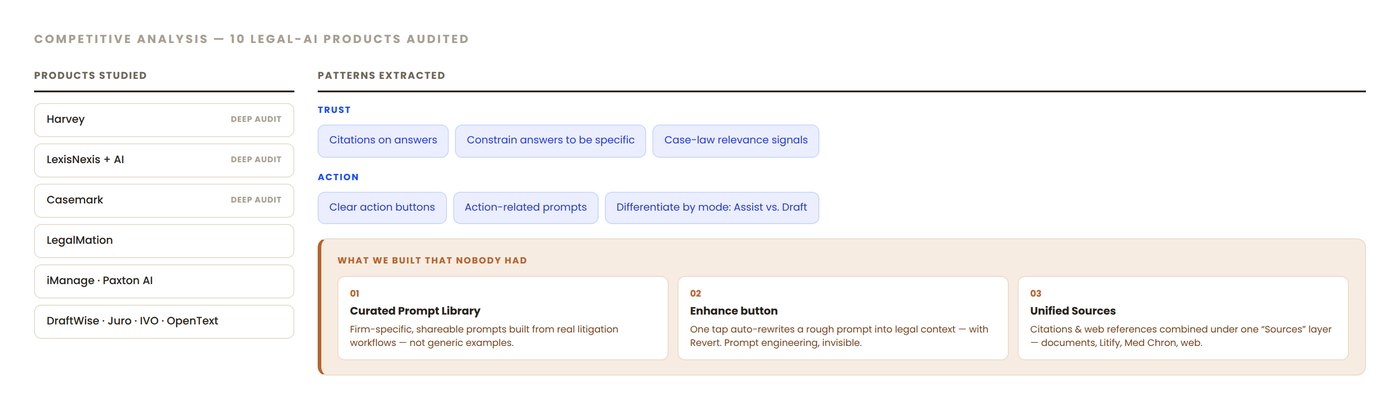
I audited 10 legal-AI products — Harvey, LexisNexis’ AI offering, Casemark, and more — extracting the patterns that earn attorney trust and drive action. What we adopted (citations, action-oriented prompts) was deliberate. What we built that nobody had — the Prompt Library, the Enhance button, and unified Sources — was more deliberate still.
I mapped the whole legal workflow before designing a single screen
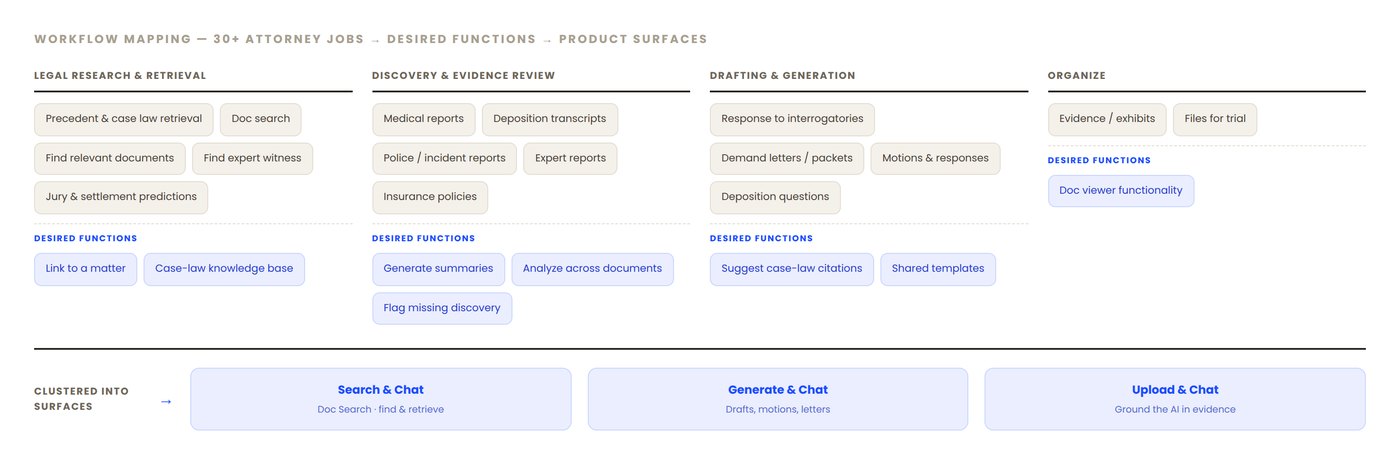
Before committing to a direction, I mapped every job attorneys do — research, discovery, drafting, organizing — into desired functions, then clustered them into candidate product surfaces. The structure of MX2 was derived, not assumed.
I explored divergent directions — then chose against one
One branch was “Max” — an assistant with named workflow categories (Search, Analyze, Generate). I tested it, then chose against it: the categories competed with the chat-first simplicity users actually wanted.
.png)
At the interaction level: three entry-point models, explicit criteria
Concept chosen, I compared three entry-point models — two-path welcome, single input, welcome-plus-workflows — each with written pros and open questions. The single-input model won on fewest clicks and chat-first simplicity, and became the shipped direction.
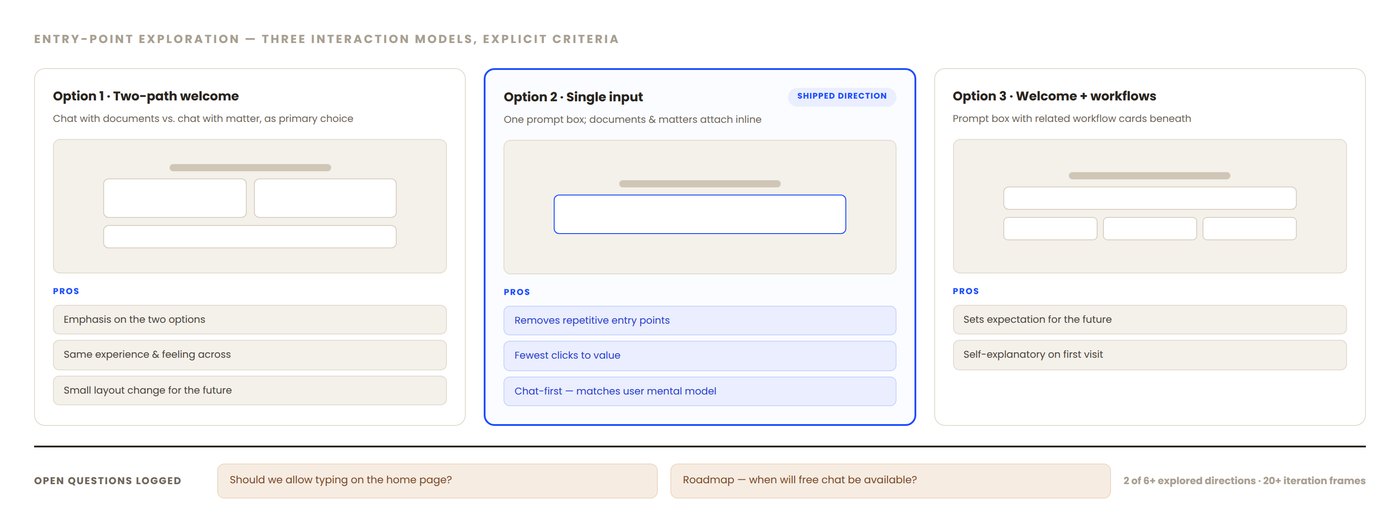
The chosen model — a single grounded input — became the low-fi foundation for the high-fidelity Matter Chat design in the next section.
Then I evaluated three entry-point models on explicit criteria
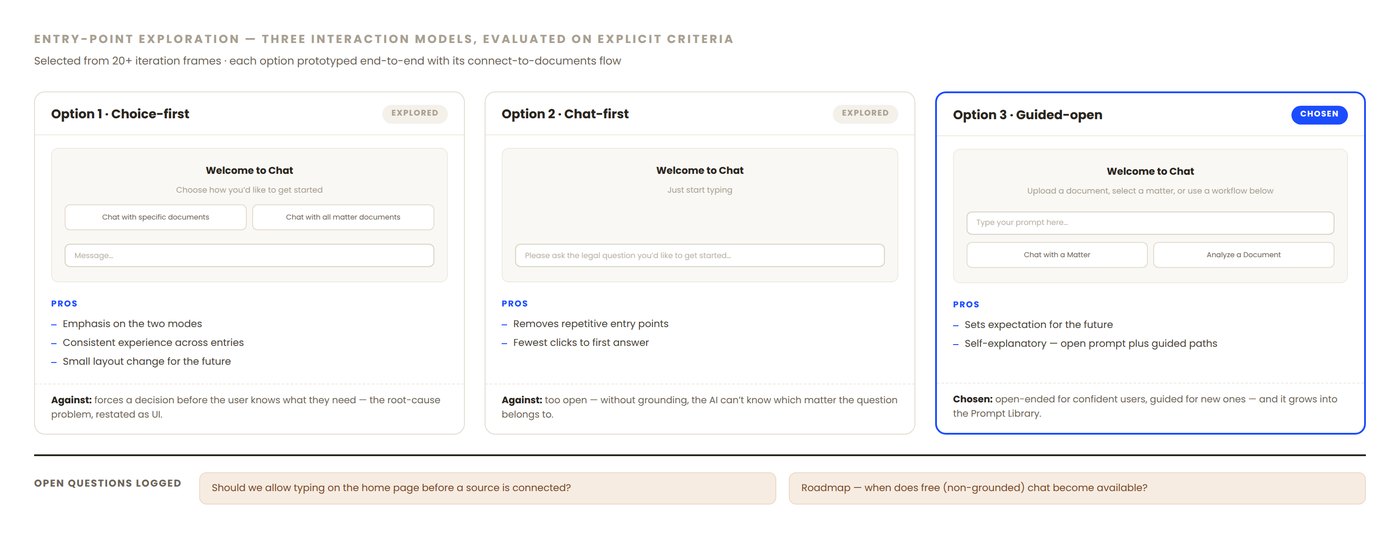
Choice-first, chat-first, and guided-open — each prototyped end-to-end. Guided-open won: open-ended for confident users, guided paths for new ones, and room to grow into the Prompt Library. Selected from 20+ iteration frames.
From Doc Chat to Matter Chat — the AI reasons over the whole case
A confident, modern AI surface
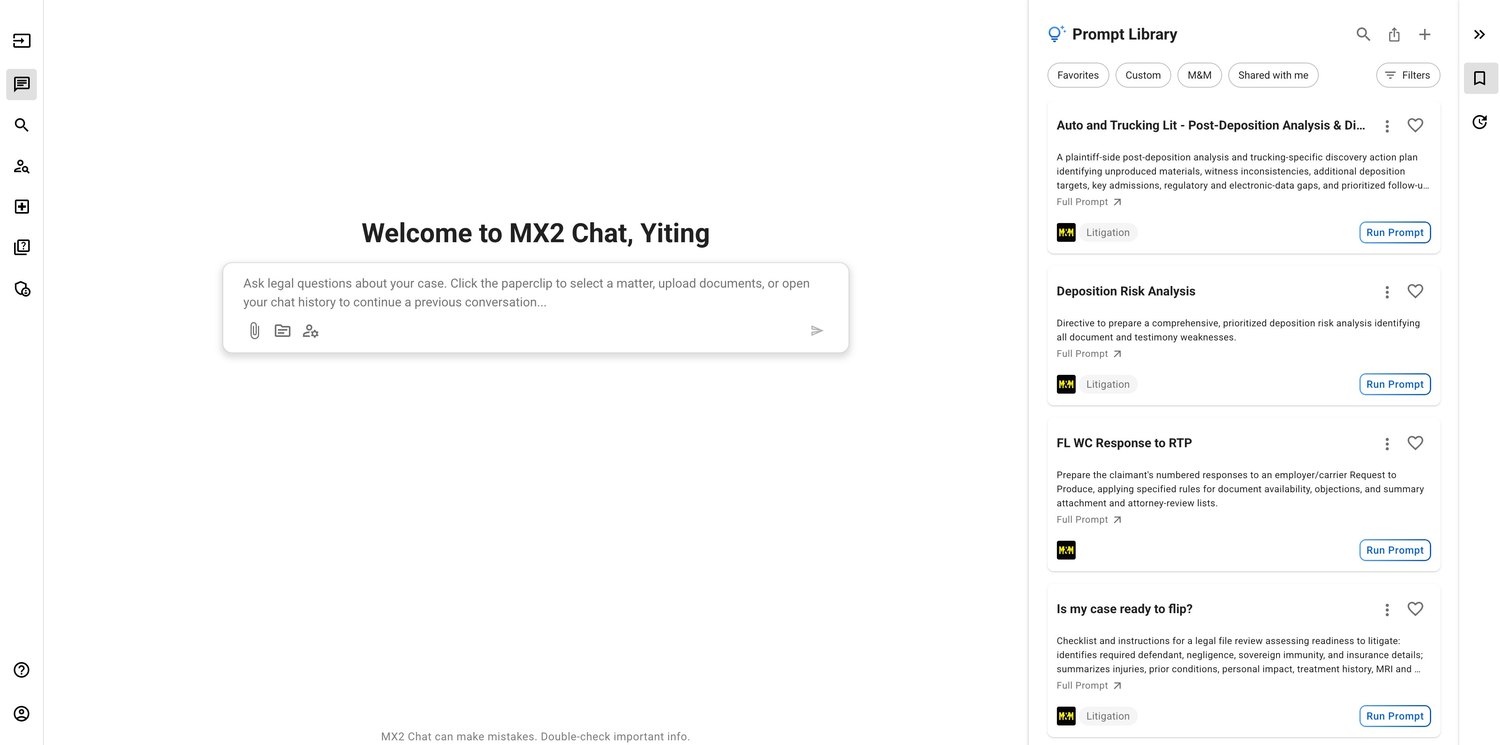
A single calm entry point replaces the old step-by-step screen. Attorneys ask about the whole matter; the AI connects to Litify automatically; a curated Prompt Library — “Deposition Risk Analysis,” “Is my case ready to flip?” — coaches users toward better questions (direct evidence of a research insight reaching the interface).
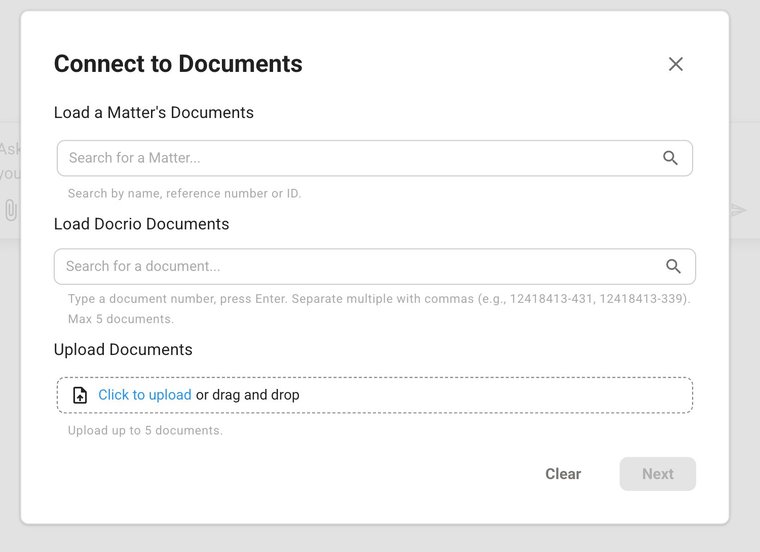
Connect to documents, three ways
Load a matter’s documents from Litify, enter specific document numbers, or upload — consolidated into one clear moment, with guardrails that set accurate expectations.
What nobody else had — shipped
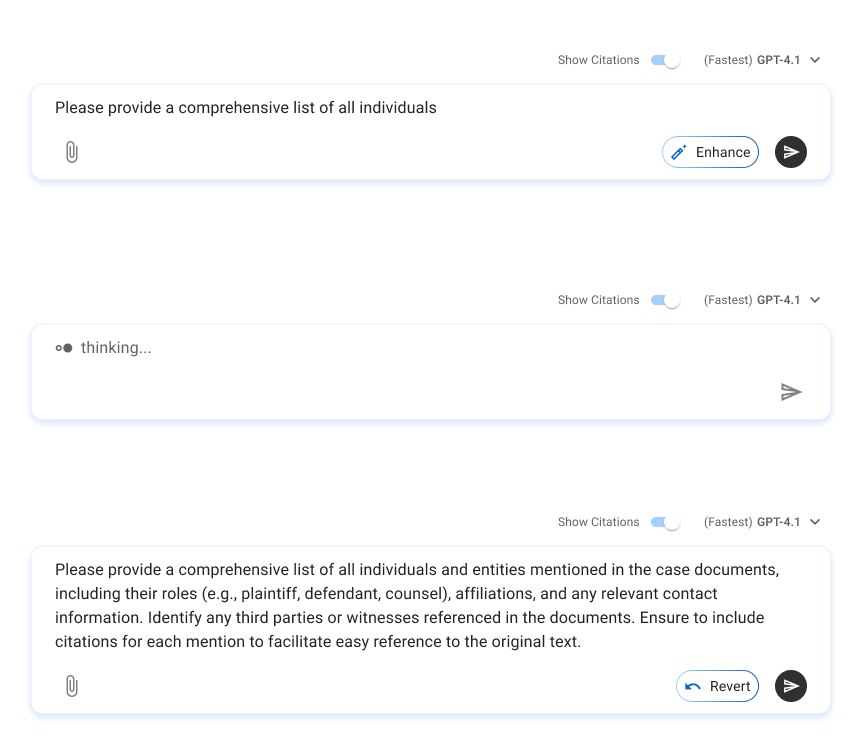
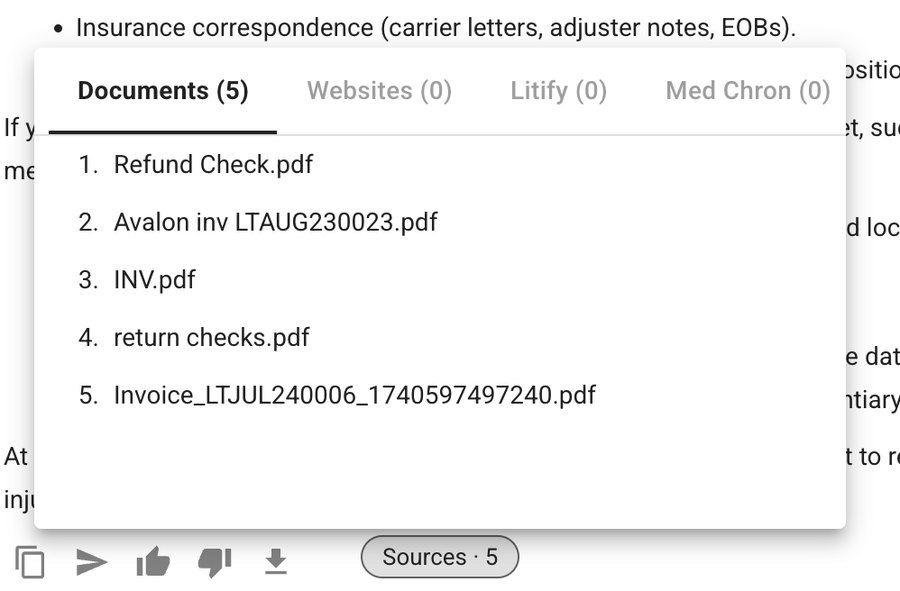
The competitive audit surfaced three gaps across every product studied. We shipped all three: the Prompt Library, the Enhance button — one tap rewrites a rough prompt into legal context, with Revert — and unified Sources, combining citations and web references across documents, Litify data, Med Chron, and the web.
Enhance — prompt engineering, invisible
Sources — one layer for every reference
From Document Management to Source Management
Managing what the AI knows was the most complex surface in the product. In a legal context, an attorney can’t trust an answer without knowing — and controlling — what the AI read. It took three generations to get right.
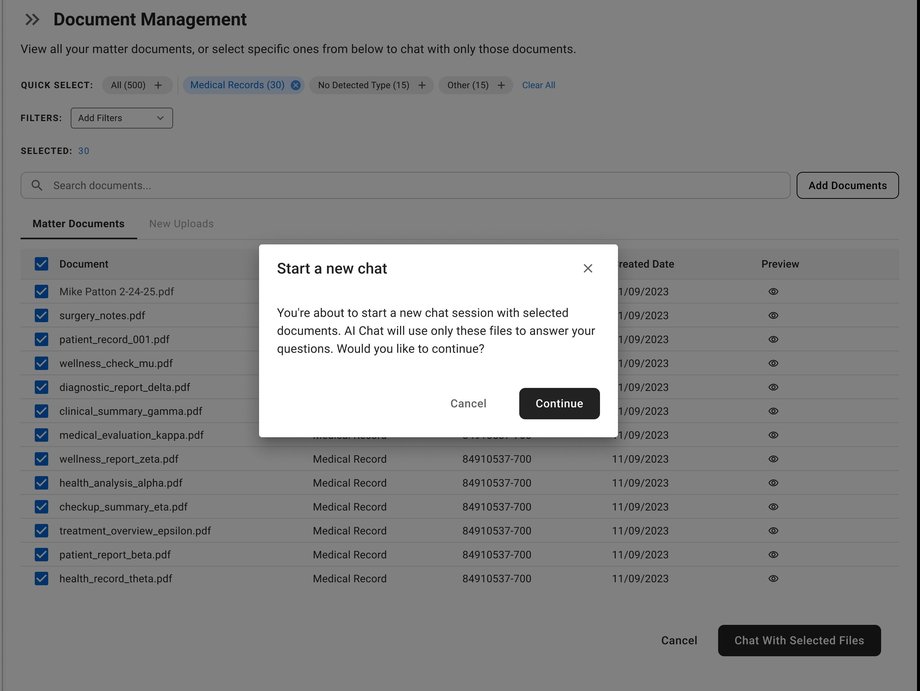
Gen 1 · powerful, but isolating
Selecting documents and hitting “Chat With Selected Files” spun up a new chat scoped to just those files. It fought the product thesis: we were promoting one matter-focused chat, but every selection fragmented users into separate sessions.
The Tension
Power vs. continuity — how do I let attorneys narrow scope without throwing away their conversation?
Move 1 · Scope in place
Selecting files now refocuses the current chat. A “Sources” pill and popover narrow scope; “Reset to All” restores the full matter. One continuous thread of thinking.
.jpeg)
Move 2 · One source
The rename to Source Management governs Matter Docs, Litify Data, MX2 Med Chron & Web Research as peers — with Excluded-From-Chat control.
.jpeg)
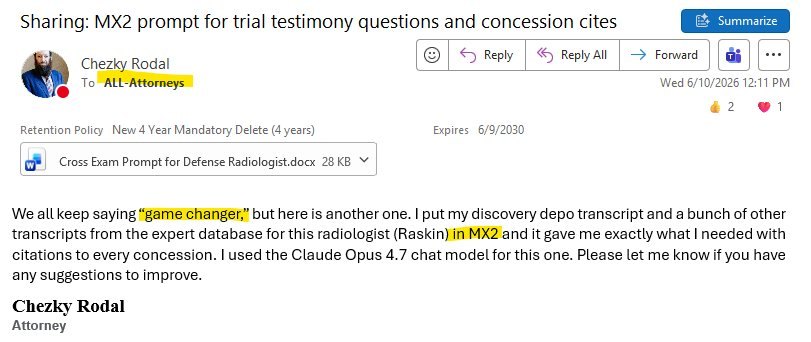
“We all keep saying game changer.”
Attorneys evangelized MX2 unprompted — and what they praised were the design decisions. Emails went to all attorneys firm-wide sharing real trial-prep workflows built on shareable prompts. One attorney reviewed 15 prior medical records and surfaced that the client had no prior neck/back complaints 5 months pre-crash — then verified it through citations before relying on it. The features they name are the ones the research demanded.
If I could do it again
What I’d measure better
I’d lock design-system tokens earlier — before the three surfaces diverged. We caught up, but earlier alignment would have cut cross-surface rework between the web app, the Word plugin, and Morgan Medical.
We tracked adoption well, but not time-to-insight or task completion. Those metrics would show value per session — whether attorneys get real answers faster — not just whether they log in.
.png)